Featuring
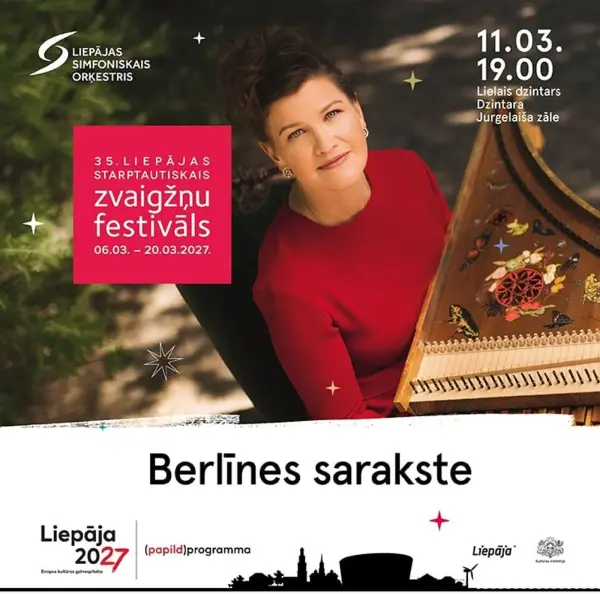
Ieva Saliete (harpsichord)
Rebeka Ruso (viola da gamba)
Program
Antoine Forqueray (1672–1745) and Jean-Baptiste Antoine Forqueray (1699–1782) Selection from the collections of pieces Pièces de Viole and Pièces de Clavecin
Christoph Schaffrath (1709–1763) Sonata in A major
Anonymous (Berlin School, c. 1760) Sonata in D major
Carl Friedrich Abel (1725–1787) Selection of pieces from the Drexel manuscript
Wilhelm Friedemann Bach (1710–1784) Polonaise No. 8 in E minor (from the cycle “Twelve Polonaises”)
Carl Philipp Emanuel Bach (1714–1788) Sonata in G minor
In the second half of the 18th century, the viola da gamba gradually yielded to the cello in European musical life, but at the Prussian court its refined sound, close to the human voice, was still especially cherished. This is also shown by the unusual correspondence between the French gamba master Jean-Baptiste Antoine Forqueray and the Prussian prince Frederick William, later King Frederick William II. In the letters, the prince tried to uncover the secrets of French gamba playing, as if attempting to keep alive an art whose age was already drawing to a close.
The concert program “Berlin Correspondence” grows out of this historical dialogue. In the music of Antoine and Jean-Baptiste Antoine Forqueray, the splendor of the French Baroque is revealed: elegance and virtuosity, sophistication and at times an almost theatrical power. In the 18th-century Berlin works, on the other hand, both the musical language and the relationship between the two instruments change: in Christoph Schaffrath’s sonata, the harpsichord is no longer merely an accompanist, but becomes an equal conversational partner to the viola da gamba.
In the second part of the program, the conversation between the instruments becomes increasingly personal and emotional. In Carl Friedrich Abel’s works, the viola da gamba remains alone, revealing its most intimate voice, while in Wilhelm Friedemann Bach’s polonaise the harpsichord leads the listener into a more unsettled musical world, full of contrasts and unexpected turns. This is music in which Baroque order meets a new sensitivity and freedom.
In Carl Philipp Emanuel Bach’s sonata, the two voices meet again. But the world is no longer the same as when the concert began. The refinement of the French Baroque has been replaced by a more direct and dramatic expression, and behind the fading tradition of the gamba, the outlines of a new age are already discernible.
This dialogue between a fading and an emerging world is revealed by two early music interpreters. Harpsichordist Ieva Saliete works with both early repertoire and contemporary music, while the Slovak artist Rebeka Ruso particularly highlights the singing, flexible sound of the viola da gamba in her interpretations.
Discounts:
Students, people with disabilities, pensioners - 5 euros
Schoolchildren - 50%
Holders of a 3+ family card - 30%
Companion of a person with disability group I/II - 50%
Groups (10 or more visitors) - 20%
When buying group tickets online, please write to sales@lso.lv
When attending the concert, the visitor must present a document proving eligibility for the discount.
The festival is supported by the Ministry of Culture of the Republic of Latvia and the City of Liepāja.