1900. The Legend of the Pianist
NB! A new offer for Riga Russian Theatre audiences: the seats are arranged directly on the stage in 5 rows (the seats in rows 1, 2 and 3 are placed on a movable platform); the seats are not numbered.
I composed this work especially for the actor Eugenio Allegri and the director Gabriele Vacis. They staged this production, and it was first shown to the public at the Asti festival in July 1994. I do not know whether it would be fair if I said that I had written this work for the theatre: I am not sure about that. At the moment, holding the book in my hands, it seems to me rather that this long piece is an approximate halfway point between a stage production and a story. I do not know whether anyone has an idea of what to call such a composition. But that is not so important. It seemed to me to be a story worth telling.
A. B.
September 1994
He said: “You are alive as long as you have a wonderful story and someone to tell it to.” He had... a wonderful story. He became that story himself. Come to think of it, a mad story, but so beautiful...
Alessandro Baricco “1900. The Legend of the Pianist”
In 1994, the third work by the Italian writer, playwright, journalist, essayist, literary and music critic, and host of intellectual talk shows Alessandro Baricco, titled “Novecento,” came to light. In Italian, it means “Nineteen Hundred” or “Twentieth Century.” But this has nothing to do with chronology or the calendar: Novecento is the protagonist’s nickname, and it is only one of the unusual linguistic traps for translators who took on this truly wonderful story: captivating, funny, moving, a little sad... and inspiring.
On the first day of 1900, a baby was found in a lemon crate aboard the ship “Virginia.” The boy became an outstanding pianist, although no one had ever taught him to play. The son of the ocean and the piano, Novecento never once set foot on land, yet he lived a life full of journeys and adventures: Paris and London, Africa and the Arctic sounded in his music... Novecento enchanted his listeners and conjured up his own desires, played “some of his own notes,” and performed a musical duel with “the inventor of jazz”... He left together with his world, which was the ship, but the legend remained.
The play has been staged many times in Italy, San Marino, France and other European countries. In 1998, Giuseppe Tornatore’s film “The Legend of the Pianist” with music by Ennio Morricone appeared on screen and won many awards, including a Golden Globe for Best Original Score. When the book was translated into Russian, the Russian actor and director Oleg Menshikov created the mono-performance “1900” (2008), which drew enormous interest from critics and audiences.
The story of the ship “Virginia”’s pianist was first staged in Riga by Dmitry Petrenko: in 2016, the concert performance “Novecento” premiered at Spīķeri, with Vestards Šimkus playing the role of the pianist, while Kristaps Ķeselis (Latvian National Theatre) took on the role of the narrator in the Latvian version, and Maksims Busels in the Russian version.
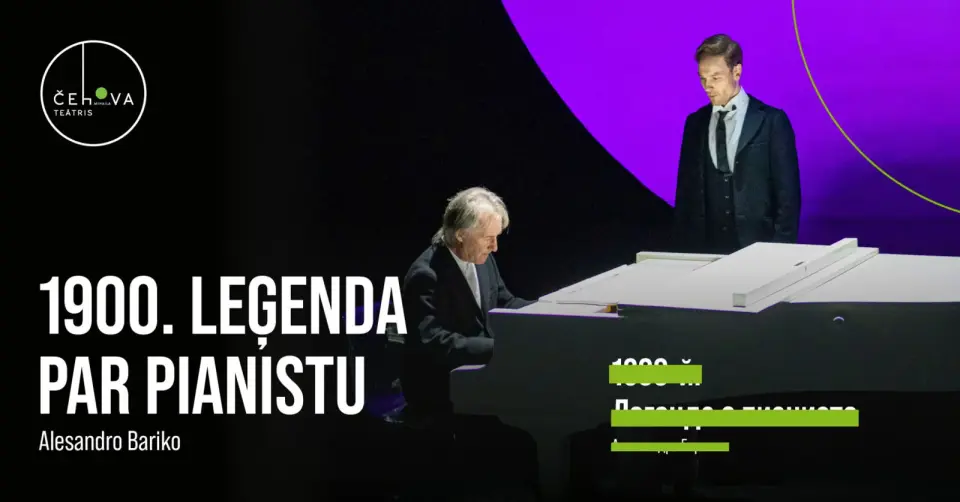
The production at the Riga Russian Theatre is neither a reprise nor a reconstruction of Dmitry Petrenko’s project, but a completely new performance with a new creative team (although audiences will once again see Maksims Busels); Uldis Marhilevičs will become the pianist. Alessandro Baricco’s musical parable has many shades and allows for the most diverse interpretations. The Riga Russian Theatre version is yet another reading of the legend of the Ocean pianist.
Alessandro Baricco was born in Turin in 1958. During his studies, he earned a degree in philosophy and graduated from the conservatory piano class, published two essays on music criticism, wrote for the newspapers La Repubblica and La Stampa, and hosted talk shows devoted to literature, music and film. In 1991, his first novel, Castles of Anger, was published, and in 1993 he became one of the co-founders of the Turin School of Writers workshop, or Holden School (Scuola Holden), which got its name from the protagonist Holden Caulfield in J. D. Salinger’s novel The Catcher in the Rye.
At present, Alessandro Baricco’s creative biography includes 13 novels, several screenplays, many essays and articles, as well as the film 21 Lessons, devoted to Beethoven’s Ninth Symphony (2008, his directorial debut).
“...the presence of music is felt in all his novels, because Baricco has two souls, literary and musical, and they are inseparable, like two communicating vessels.
Music, philosophy, architecture, painting, history, literature - this is where he finds the endless plots of his compositions, in which his characters are also born: geniuses and eccentrics, dreamers and mad inventors; all his characters remain memorable for a long time: Mister Rail and Pekish from Castles of Anger, Hervé Jancour from Silk, Bartleboom and Plasson from Ocean Sea and, of course, Danny Boodman T. D. Novecento - the brilliant pianist who plays in the middle of the ocean...” (Natalija Kolesova, translator)
“This story, alien to modern problems, is almost a fairy tale. It is inhabited by an extraordinary pianist who is born and dies on a ship, never once stepping ashore. Baricco focuses on the idea rather than the style: he begins one phrase, from which another character is born, then moves on to a new phrase, and so on. Just like in life.”
Arnoldo Foà Scandian (actor)
Notikuma Informācija
Date & Time
10. Nov at 19:00
Until: 10.11.2026 21:00
Organizer
Mihaila Čehova Rīgas Krievu teātris SIA
Admission
From €0
Similar & Related Events
Other events in this region or category